Mistakes and Failures are like Illness

As I have experienced illness several times, I have done many mistakes and failures in life too. Illness is an opportunity, though a dangerous one, so does mistakes and failures where it forced and allowed me to think in new ways about the value of life. Illness is something to recover from if I can, but recovery is worth only as much as what I learn about the life I am regaining.

To seize the opportunities offered by mistakes and failures, we must live with them actively: we must think about it and talk about it, and some, like me, must write and reflect about it. Through thinking, talking, and writing we can begin, as individuals and as a society, to accept mistakes and failures fully and positively look at them. Only then can we learn that it is nothing special but a room for improvement.

Being ill is just another way of living, but by the time we have lived through illness, we are living differently. Same with mistakes and failures, it can lead us to live differently, and accepting them is neither natural nor self-evident, but the people surrounding us can make the process of acceptance easy. We only need to hear positive, supportive and encouraging words from them, and we will feel strong and finds ways to correct our mistakes.

My favorite type of assessment


As a student, what kind of assessment did I prefer to take?  What types of assessment were/are threatening for me?  Why?

When I was in high school, I always prefer to take the short quizzes, given by dictation or reading the Manila Paper posted on the blackboard, as I had high chances of getting a perfect score and I do not have to study too long. The quizzes were easy because most of the time it will be identification, so if I memorize the lessons, I always get a high score, and it makes me happy. However, when I was in college, I still preferred the formative assessment, but this time in a paper and pencil tests. Likewise, I liked the identification part because it was more of memorization, and I liked the multiple choice as well because I only have to analyze the question. On the other hand, a summative assessment that included an essay part was threatening to me when I was in college because I was afraid that I missed keywords in my essay. However, after undergrad studies, I liked to take-home exams, especially on essays as I can do some research and substantiate my essay. It gave me comfort that I have done my best to answer the essay assignment.

Another threatening assessment for me was an informal assessment. Due to the poor validity and reliability of this assessment, I always perceived that my teachers had favoritism, and I felt that if don’t try to please my teacher or if I don’t behave, I will be less favored, so lower grades.

What factors influenced how I chose to prepare for an upcoming assessment (exams, projects, or other assessment tasks)?

Time is the main factor that influenced my preparation for any upcoming assessments. If I am given enough time, I tend to be more prepared and confident to take the exam. However, if the time is very long, I tend to become relax with the preparation, but it allows me to study deeper about the concepts, and sometimes I feel that I am an expert earner about the concept. Another factor is the availability of materials to study. Most of the time, I will access the internet to find out the latest information about a topic. However, if there are only very few materials available, it makes me less interested because I feel that I only need to study a particular material to pass the assessment.

What kinds of test do I perceive will be threatening to learners (e.g., my students)?  How do I explain this situation, using my new understanding of materials from this module?

Summative exams are threatening to the students especially if this is given more weight than any other assessments combined. Informing students in advance on the requirements on how they will be objectively assessed for the summative exams will encourage students to be engaged with their learning.

As an educator (current or future), what kinds of assessment do (will) I prefer to give?  Why?

As a future educator, I prefer to give take-home reflective exam because this type of exam do not only shows a deep understanding of the students about the topic but also their written communication skills. It will help them develop to articulate their ideas in a more organized manner, and this will become a transferrable skill in real-life.

What new insights emerged from this lesson? 

‘Students can, with difficulty, escape from the effects of poor teaching, they cannot (by definition if they want to graduate) escape the effects of poor assessment.’ David Boud

The above quote concretely describes the new insights from this lesson. The assessment must be well-prepared, so it meets the principles of validity and reliability. It has to be an effective assessment design, so we can establish exactly what we are trying to achieve in a particular type of assessment. Every teacher has to realize that assessment design can have as big an influence on what our students learn as our teaching. Students may have a real passion for their subject, but for many, the goal of a university education isn’t necessarily to deepen their understanding of their chosen discipline, it’s to get ‘a degree.’ As such, their learning may be more focused on what they need to know to pass their coursework and exams.

Ideally, the methods of assessment we use should do more than award a grade – they need to serve as an aid to students’ learning, allow them to gauge their progress, get feedback on their strengths and weaknesses, and consolidate their learning. This fits with the concept of Assessment for Learning. However, the assessment also has to meet quality assurance standards. These two, almost opposing requirements of assessment make effective design a real challenge, but doing it well can help our students to better engage with the subject and their learning; potentially reduce our assessment workload, and may help to reduce the number of plagiarism cases.


In what ways do I find the lessons in this module personally important? 

We are all aware that the nature of assessment is known to affect students’ approaches to learning and research has shown that students are more likely to adopt ‘surface’ rather than ‘deep’ approaches to learning if regurgitation of knowledge is the main criterion being assessed. But assessment satisfies some different purposes in addition to student learning, such as classifying achievement, quality assurance and supporting lifelong learning. In an ideal world, the assessments that we use should be sufficiently diverse and balanced to support these different (and diverse) purposes.

Also, I realized that the nature of assessment can also have a significant impact on our working life. Do we find ourselves bored to tears when it comes to setting and marking that pile of 50 essays on our desk? Do we get wrapped up in cases of academic misconduct when our time would be better spent writing grant proposals? Do we yearn for students to read beyond the standard texts and to draw together their learning from across a wide range of modules? And do we hear ourselves asking “there has to be a better way of assessing these students”? If we answer yes to any of these, then the time may well have come for us to take some time to consider whether or not an alternative method of assessment is right for our students (and for us).
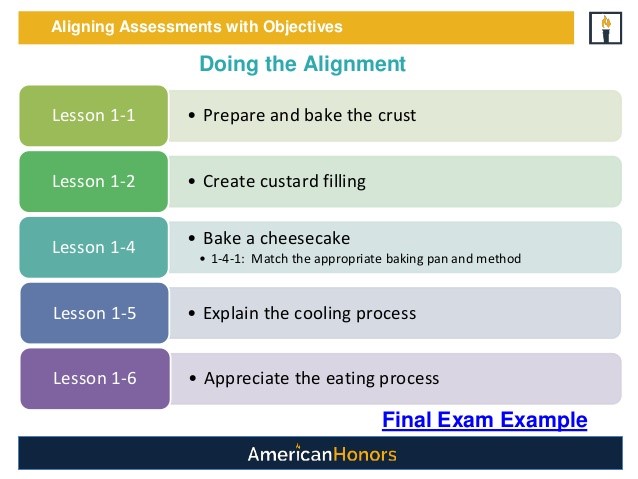
Aligning Assessments with Learning Objectives

A

According to literature, assessments should provide instructors and students with evidence of how well the students have learned what the key learning objectives of the course are. What we want our students to learn and be able to do should guide the choice and design of the assessment. There are two major reasons for aligning assessments with learning objectives. First, alignment increases the probability that instructors can provide students with the opportunities to learn and practice the knowledge and skills that will be required on the various assessments designed for the course, (or subsequent learning). Second, when assessments and objectives are aligned, “good grades” are more likely to translate into “good learning”. When objectives and assessments are misaligned, many students will focus their efforts on activities that will lead to good grades on assessments, rather than focusing their efforts on learning what may be important for application of their learning.

From now on, every time I will create a course, I will strive to design with the end in mind. After establishing a set of measurable learning objectives for my course, I will work to develop assessments that are aligned with my stated learning objectives. I should think of the learning objectives as a set of skills, knowledge, or abilities that my students will be able to demonstrate a mastery of at the end of the course. Then I will consider the assessments as a way for the student to prove they are capable of that mastery.

Wherever possible also, it is good to plan the assessment, including full details of each assessment task, at the time the course outline is initially developed, so that learning outcomes can be seen to be assessable and achievable within the timeframe of the course.

Often, learning outcomes are framed well in advance of detailed assessment plans—for example, to accord with professional accreditation requirements. Then, when the assessment plan is being developed, and it becomes clear that the approved learning outcomes were framed poorly, it is too late to change the outcomes, and uncomfortable compromises have to be made.

Why Learning Feedback is Important?

Feedback in the assessment is very important. Its purpose is to encourage and help students to learn better. There are many ways of feedback like written assignments, oral homework, quiz, performance and so on. Feedback can be both assignment reviews, modification, symbols, annotations, interview with the individual or give comments to all the students.

During the classroom activities, teachers carefully observed and record every student’s performance. After activities teachers immediately gave feedback to students, such as pointing out students’ strengths and deficiencies in the performance and gave them instructions on how to do it well next time. The teacher also had an individual dialogue with students to better understand the students. No matter what formative assessment is undertaken, teachers’ feedback must be objective and fair, because if the formative assessment doesn’t deal well, it will not produce good results. For example, to encourage the students, no matter how students perform, some teachers always say to students “very good,” or “good.” If students find no matter how they perform, they will easily get praise. This will be very hard to move students to a higher goal.

Therefore, although praise is very important, it must be based on students’ true progress. Students need to know where they do well so that they can progress faster. Feedback also helps students have self-assessment. Richard Sober (2009)  stressed self and peer assessment could make students reflect on their contribution to the team and also voice their opinions on their co-workers and it is essential they have confidence that a sense of fairness will prevail in the marking process.

Richard G. Sober. (2009). Team working and Peer Assessment: The assessment process as an aid to effective learning in creative group project work. The Higher Education Academy http://www.adm.heacademy.ac.uk/resources/case-studies/teamworking-and-peer-assessment-the-assessment- (accessed 20\2\2010) st Table 3;\lsd

Assessment and how to make it meaningful

Assessment and Knowing Your Students

As a teacher, you will constantly make instructional decisions based on assessment results. Accomplished teachers realize that evaluating student understanding and progress goes hand in hand with instruction. Essentially, assessment   is the umbrella term we use to consider the broad topic of evaluating how students are and should be progressing. Assessment includes formal assessments (that provide a way for us to learn how students are performing compared to their peers) as well as informal assessments (that let us understand how students generally do within specific skills, con- tent areas, or tasks). 

Individuals often use the term assessment   to argue for and against many school initiatives, laws, and policies. Assessment, therefore, has been implicated with negative reactions because of issues such as the achievement gap between students with and without disabilities.

Despite the negative associations with assessment, it is a critically important aspect of instructing students with and without disabilities. Without the information that assessment provides, how would we know whether the instruction we are providing is making a difference?

Why test in relationship to the standards? It is important to see if students are making progress toward a predetermined set of standards to make sure that they are learning the skills necessary to succeed as they move through the grades and into postsecondary life. Using the standards to gauge student learning allows teachers to determine whether instruction is resulting in necessary student gains. If students are not making anticipated gains, schools and school districts can allocate resources to support student learning in weak areas.

Making Assessment Meaningful

In order to devise lessons that result in student learning, the teacher must also consider how students learn. Different types of learners require different types of lessons. For example, a student who learns best visually will learn better from visual stimuli like photos or demonstrations where a tactile learner needs to move around or learn by doing. Once the teacher and student have assessed how the student best acquires knowledge, they can work to structure his working environment accordingly. fffff

Importance of reflective learning

It is only through reflection that true learning occurs.

The science behind reflection is compelling. We know intuitively that we learn by experience and also that we learn from our mistakes. But research is increasingly telling us that without the process of actively thinking about those experiences, and questioning ourselves about what they mean, learning doesn’t really happen. What gets us from experience to understanding is reflection. 

Reflection can take many forms and encompass many activities. So, I have selected e-journaling, so I can access them all the time. I believe that this e-journaling reflection can be a powerful, free tool for developing my skills, confidence and motivation.